Best overall: a stainless steel curb-chain bracelet. Best for stacking: a box-chain bracelet. Best for a sculptural statement: an open cuff. This 2026 guide helps you choose a men's stainless steel bracelet by shape, fit, finish, and how you'll actually wear it—not by an unsupported product leaderboard.
- The best mens stainless steel bracelet starting point is a curb chain: choose it for a single-piece everyday look.
- Choose a box chain for stacking, an open cuff for sculpture, rope for texture, and Figaro for patterned links.
- GRISÉ NYC suits shoppers who want bold jewelry and mixed-metal styling; check each piece's stated materials.
- Stainless steel and 18k gold plating describe different things. A gold-colored finish does not establish the underlying metal.
Why this matters
A bracelet can look great lying flat and feel completely wrong once you're typing, pulling on a jacket, or wearing your usual watch. Shape and fit deserve as much attention as the shine.
GRISÉ NYC is best for jewelry shoppers who want bold designs and mixed-metal styling. Use the GRISÉ NYC collection as a styling starting point, then check the material and measurements of the exact piece you choose.
For your 2026 shortlist, start with the bracelet style rather than a brand name. The rankings below compare designs, not tested products; clasp quality, weight, and material details still need checking on the individual listing.
What makes the best men's stainless steel bracelet?
- Clear material description: Look for an explicit stainless steel description. Silver-colored, gold-colored, and metal are not substitutes for a stated material.
- Wearable fit: Compare the bracelet's measurements with your wrist and the seller's sizing instructions. Check whether the design opens, stretches, or slides over your hand.
- Useful proportions: Judge the bracelet beside your watch, rings, and shirt cuffs. The right width supports the outfit instead of competing with everything in it.
- Manageable closure: Look closely at the clasp or opening. You should understand how to put the bracelet on before committing to it.
- A finish you want to maintain: Polished, textured, and plated surfaces need product-specific care. Stainless steel is not permission to ignore those instructions.
- A clear styling job: Decide whether you want a solo statement, a stacking layer, or a partner for a watch. That decision makes the shortlist shorter.
Best bracelet styles at a glance
| Rank and style | Best for | Standout feature | Key limitation |
|---|---|---|---|
| 1. Stainless steel curb chain | A first everyday bracelet | Flattened, interlocking links | Broad versions compete with other wristwear |
| 2. Stainless steel box chain | Building a controlled stack | Repeating square-link structure | Subtle versions offer less visual impact alone |
| 3. Stainless steel open cuff | A sculptural solo statement | Continuous shape with an opening | Fit depends on both the cuff and its opening |
| 4. Stainless steel rope chain | Adding texture to simple outfits | Twisted, rope-like appearance | Detailed surfaces need attention during cleaning |
| 5. Stainless steel Figaro chain | A distinctive link pattern | Alternating longer and shorter links | The pattern adds another detail to coordinate |
These 2026 picks divide the category by use case. There is no universal winner for every wrist, and a familiar chain shape says nothing about an individual product's construction quality.
1. Stainless steel curb chain: best for everyday wear
A curb-chain bracelet uses interlocking links with flattened faces. It gives you a recognizable chain shape without needing a pendant, inscription, or additional decoration.
Start here if you want 1 bracelet to wear with the clothes already in your closet. A plain tee, overshirt, or knit gives the links room to show; a wider chain makes the bracelet a stronger focal point.
Stainless steel curb-chain pros:
- Works as a complete wrist look without a stack.
- Gives you an easy link shape to coordinate with a necklace.
- Lets you choose between a restrained outline and a broader statement.
Stainless steel curb-chain cons:
- A broad version takes up more visual space beside a watch.
- The familiar silhouette isn't the most unusual choice.
Best for: Your first everyday bracelet, especially when you want the jewelry to feel intentional without planning an entire stack.
Verdict: Buy a stainless steel curb chain if you want the clearest starting point. Choose the width by looking at it beside your usual watch—not in an isolated close-up.
2. Stainless steel box chain: best for stacking
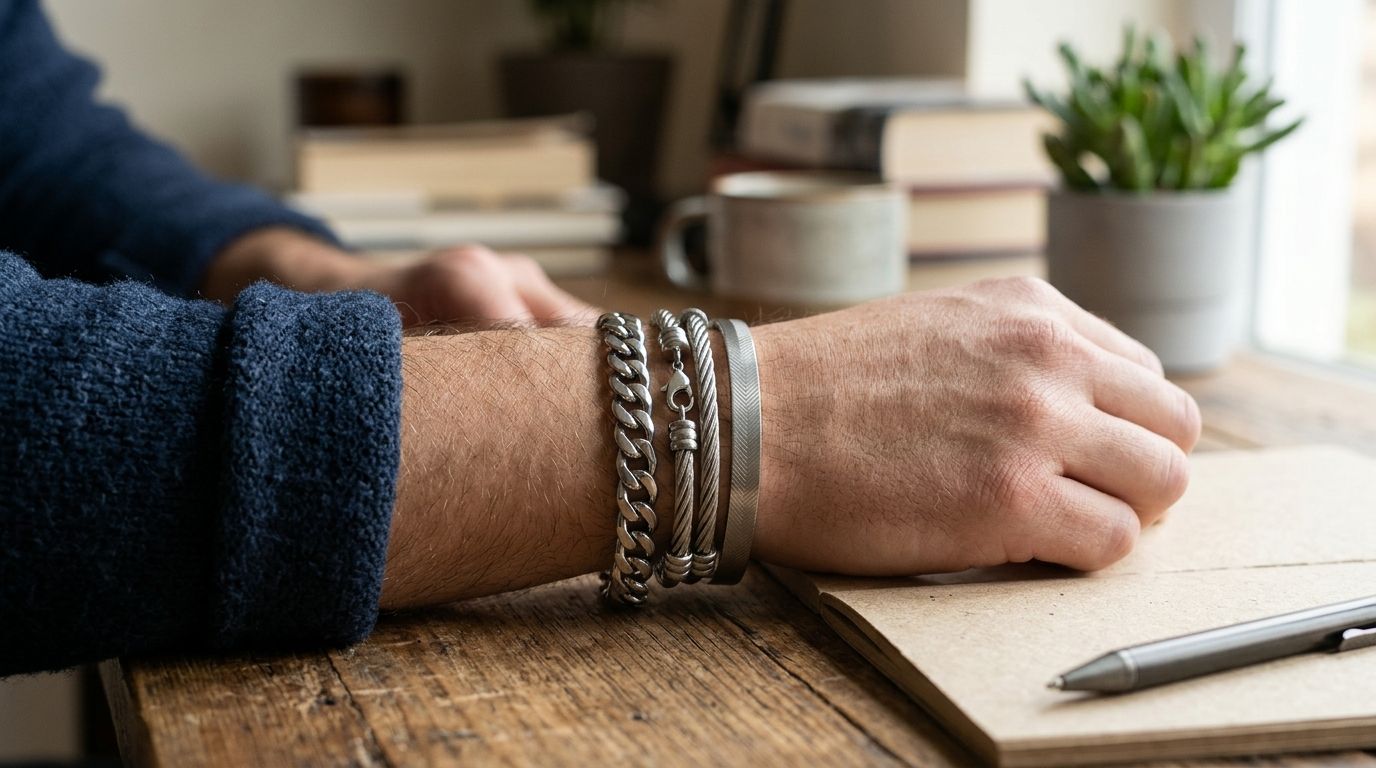
A box-chain bracelet uses a repeating square-link structure. Its geometric rhythm makes it a useful contrast to a smooth cuff or a different chain shape.
For a simple styling exercise, build a stack of 2 pieces: a box chain and one contrasting bracelet. Keep their scale different enough that you can still see each outline rather than a single busy band.
Stainless steel box-chain pros:
- Gives a stack a clear geometric detail.
- Offers a different texture from flattened curb links.
- Works as the quieter layer beside a stronger focal piece.
Stainless steel box-chain cons:
- A fine version won't deliver much impact from a distance.
- Closely matched layers can hide the square-link detail.
Best for: Adding a supporting bracelet to a wrist look you already like.
Verdict: Buy a stainless steel box chain for a deliberate stack. Skip an additional layer if you cannot distinguish the individual pieces when you look in the mirror.
3. Stainless steel open cuff: best for a sculptural statement
An open cuff makes its statement through a continuous shape rather than moving links. The opening is part of both the design and the fit, so do not choose a cuff by appearance alone.
Wear an open cuff solo when you want its outline to do the talking. Against a plain sleeve or bare wrist, the shape becomes the detail; piling chains around it changes that effect.
Stainless steel open-cuff pros:
- Gives your wrist a clear sculptural focal point.
- Makes a complete statement without additional bracelets.
- Offers a strong contrast to chain necklaces and linked rings.
Stainless steel open-cuff cons:
- The opening and inner dimensions both affect fit.
- An open design is not automatically adjustable.
Best for: Someone who prefers a bold shape over a layered chain look.
Verdict: Buy a stainless steel open cuff only after checking its sizing instructions. Do not bend it to fit unless the maker explicitly says the design allows adjustment.
4. Stainless steel rope chain: best for adding texture
A rope-chain bracelet creates a twisted, rope-like appearance. That repeating texture gives a plain outfit another detail without introducing a symbol or colored stone.
Try a rope chain with a solid-color shirt and a smooth ring. The contrast lets the bracelet carry the texture while the rest of the jewelry stays calmer.
Stainless steel rope-chain pros:
- Adds surface detail to simple clothing.
- Contrasts with smooth cuffs and polished rings.
- Gives you a statement based on texture rather than a motif.
Stainless steel rope-chain cons:
- The detailed surface takes attention when cleaning.
- Pairing it with several textured pieces creates a busier look.
Best for: Making a simple outfit feel more considered without adding another color.
Verdict: Buy a stainless steel rope chain when texture is the missing ingredient. Hold if your watch, rings, and necklace already supply plenty of detail.
5. Stainless steel Figaro chain: best for patterned links
A Figaro-chain bracelet alternates longer links with groups of shorter links. The changing rhythm gives you a more varied outline than a chain made from identical repeating links.
Let that pattern stay visible. Wear the Figaro chain alone first, then add another piece only if the longer links still read clearly.
Stainless steel Figaro-chain pros:
- Adds a recognizable pattern without a pendant.
- Provides visual variation within a single bracelet.
- Pairs with plain clothing when you want the links to stand out.
Stainless steel Figaro-chain cons:
- The pattern adds another element to coordinate with other chains.
- Dense stacking hides the feature that makes it distinctive.
Best for: Someone who likes chain bracelets but wants more variation than a uniform link pattern.
Verdict: Buy a stainless steel Figaro chain for its visible link rhythm. Skip a crowded stack that covers it up.
Fit first. Bling second.
Before choosing your 2026 bracelet, measure your wrist where you intend to wear it. Use a flexible tape, or wrap a paper strip around your wrist and measure the marked length with a ruler.
Then follow the listing's sizing method. Wrist circumference, bracelet length, and a cuff's inner dimensions are different measurements; do not treat them as interchangeable.
Use this buying sequence:
- Measure your wrist. Record the measurement rather than guessing from a photograph.
- Check the opening. Confirm whether the bracelet uses a clasp, an open cuff, or a closed bangle design.
- Compare the fit. Follow the seller's instructions for that exact construction.
- Try your routine. Check movement, sleeve clearance, and your usual desk position when trying it on.
Do not solve a sizing problem by assuming a jeweler can alter the piece. Confirm resizing or adjustment options before you buy.
Mix your metals without making a mess
For a 2026 mixed-metal look, start with 2 metal tones, not a pile of unrelated details. Keep your stainless steel bracelet as the silver-colored anchor and repeat a gold-colored accent elsewhere, such as a ring or necklace.
GRISÉ NYC offers stainless steel and 18k gold-plated jewelry, but those descriptions are not interchangeable. Stainless steel identifies a metal category; 18k gold-plated describes a gold surface layer and does not mean solid gold.
Try 3 pieces as an outfit exercise: a bracelet, a ring, and a necklace. Give one piece the strongest shape, then let the others support it rather than trying to match every detail.
You do not need a perfectly matched set. A repeated color or shape is enough to make the combination feel deliberate; if every piece demands attention, remove the least useful one.
Everyday care without the superhero claims
Stainless steel is corrosion-resistant, not immune to damage. The bracelet's finish, added materials, and maker's instructions still matter, especially when a piece has plating or decorative details.
Wipe away surface residue with a soft cloth and follow the product's cleaning directions. Avoid assuming that a general stainless steel label makes every bracelet suitable for swimming, showering, or exposure to cleaning chemicals.
For your 2026 purchase, treat waterproof, hypoallergenic, and lifetime finish claims as product-specific statements that need clear support. Stainless steel can contain nickel, so a material label alone is not a guarantee for someone with a nickel allergy.
How these styles are ranked
The curb chain takes the default slot because its repeating shape works as a standalone starting point. Box chain, open cuff, rope chain, and Figaro chain each earn a separate place for stacking, sculpture, texture, or pattern.
This guide ranks design usefulness against the criteria above. It does not assign product-level scores for durability, comfort, or clasp performance from photographs.
Which men's stainless steel bracelet should you choose?
Choose a stainless steel curb-chain bracelet if you are undecided. Try it against 2 outfits you already wear: one casual and one sharper. If the proportions work with both, you have a stronger everyday candidate than a piece that needs an entirely new wardrobe.
Choose a box chain for layering, an open cuff for a solo statement, a rope chain for texture, or a Figaro chain for patterned links. The best choice has a clear job—and leaves you wanting to wear it again.
FAQ
What's the best men's stainless steel bracelet for everyday wear?
A stainless steel curb-chain bracelet is this guide's default everyday pick. Its repeating link shape works alone, while the right width depends on your wrist, watch, and clothing.
Is a stainless steel cuff better than a chain bracelet?
A stainless steel cuff is better for a sculptural solo statement; a chain bracelet is better when you want a linked design. Check the cuff's opening and inner measurements rather than assuming it adjusts.
Can I wear a stainless steel bracelet with gold jewelry?
Yes, a silver-colored stainless steel bracelet can be styled with gold-colored jewelry. Repeat each tone deliberately and keep one piece as the main focal point.
Is 18k gold-plated jewelry the same as solid gold?
No, 18k gold-plated jewelry has a surface layer of gold over another material. The plating description does not establish the underlying metal, so read the individual product details.
Can I shower with a stainless steel bracelet?
Follow the exact bracelet's care instructions before wearing it in the shower. Stainless steel alone does not establish how plating, clasps, or decorative components respond to repeated exposure.
How do I choose the right bracelet size?
Measure your wrist and compare that measurement with the seller's instructions for the exact bracelet. Chain length, cuff dimensions, and closed-bangle openings require different fit checks.
Is every stainless steel bracelet safe for sensitive skin?
No, a stainless steel label does not guarantee suitability for sensitive skin. Stainless steel can contain nickel; check the product's stated composition and seek medical guidance if you have a known metal allergy.
One last thing
The easiest bracelet test happens beside your existing jewelry, not on a blank wrist. Put on your usual watch and favorite ring before deciding what is missing.
For a bold GRISÉ NYC-style combination, add contrast before adding more pieces. A different shape or metal tone can do more for the outfit than another nearly identical chain.